Context
Rather than describe the technology, NekaSoft wanted to show its RAG expertise with a working interactive product: a live assistant a potential client can try out right on the site.
A visitor can ask questions about NekaSoft, get answers from the real knowledge base, see the sources used, add their own test data, and immediately check how the same RAG pipeline works with their information.
So the product is three things at once: a demonstration of NekaSoft's RAG expertise, a real AI interface to the company's knowledge, and an interactive touchpoint for potential clients. It is a production demo: you test the technology yourself instead of reading about it.
What we owned
NekaSoft built the product end to end and continues to develop it.
Product & user flows
- Product concept
- User flows
- Knowledge-base structure
- RAG architecture
RAG pipeline
- Ingestion and indexing
- Embeddings and semantic retrieval
- AI orchestration and grounding
- Refusal logic when context is insufficient
- Citations
Product features
- Assistant web interface
- Own-data test mode
- Session isolation
- Automatic deletion of temporary data
- Human handoff with Telegram as the team channel
Run & evolve
- Deployment
- Automatic knowledge-base rebuild from site content
- Ongoing development
Solution
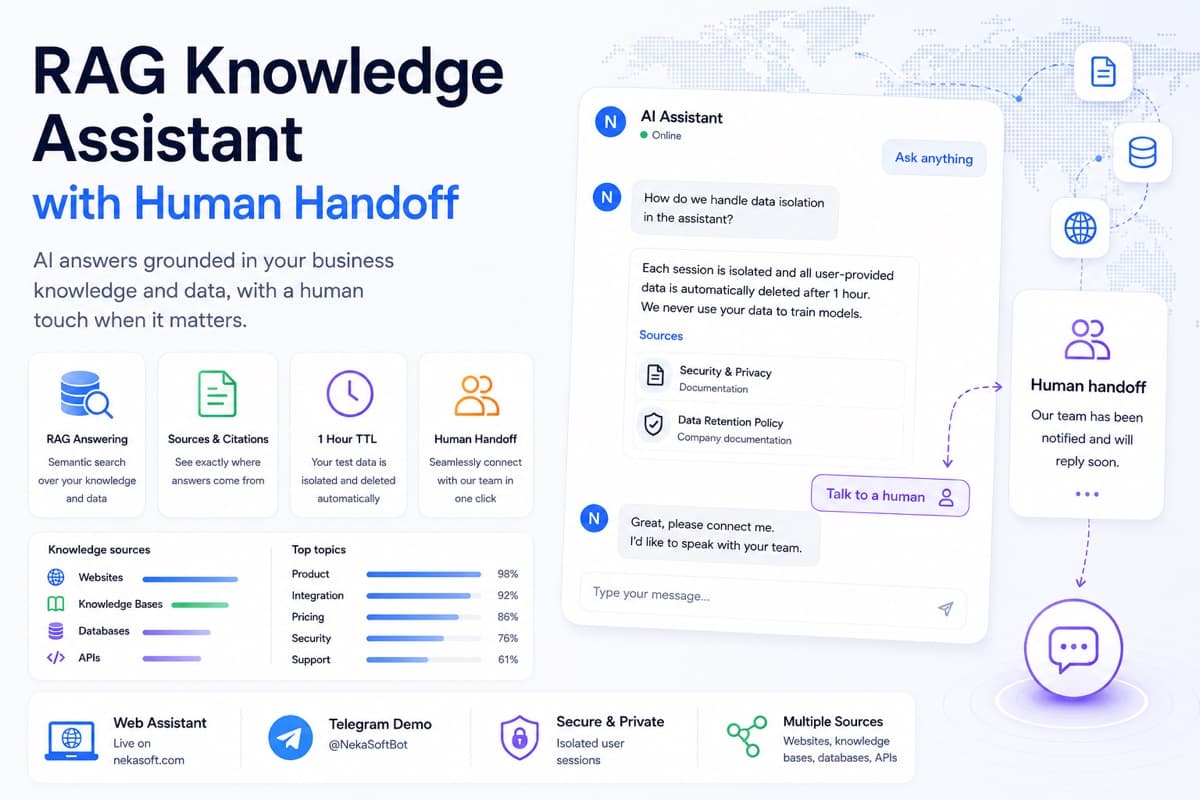
The assistant works with a dedicated, indexed knowledge base; NekaSoft's own base covers project kinds and typical situations, portfolio cases, the process, FAQ, and company facts. On every question the system retrieves the relevant fragments, passes them to the model, and returns a grounded answer.
- Semantic retrieval over an indexed knowledge base
- Answers grounded in the retrieved context, with sources shown
- Honest no-answer behavior: if the base has nothing relevant, the assistant says so instead of guessing
- Own-data test: your text goes through the same pipeline, isolated within your session
- Temporary data never enters the permanent base and is deleted after 1 hour
- Human handoff: the conversation goes to the team's Telegram, and the reply returns to the same web dialog
- The knowledge base rebuilds automatically from the site's content on every deployment
- Two working interfaces: the web assistant on this site and the @NekaSoftBot Telegram demo
The system is designed to answer from retrieved context and to decline a substantive answer when there is not enough of it. The same architecture can be connected to websites, internal knowledge bases, documents, CRM systems, databases, and APIs, and can power different client channels.
Screenshots
Result
The result is a production RAG demo that potential clients can try for themselves.
- Ask a question against a real knowledge base and get a grounded answer
- See the sources each answer is based on
- Check the behavior when the base has no answer
- Add your own test content and check retrieval on it
- Hand the conversation to the team without leaving the chat
- The same architecture applies to sales, support, onboarding, internal knowledge, and policy assistants
Production status
The assistant runs live on this site: the chat in the bottom-right corner and the AI demo page, where the knowledge base is open for inspection.
@NekaSoftBot remains a standalone Telegram demo of the same RAG concept. NekaSoft continues to develop the product.
Technology
The web assistant runs on Next.js and Node.js, with the OpenAI API for embeddings and answer generation; semantic search works over an indexed corpus rebuilt automatically from site content on each deployment. The Telegram demo uses grammY, MongoDB, and the Telegram Bot API.
Want an assistant that answers from your business knowledge, shows its sources, and hands tricky conversations to your team?